
Personal finance for early-career professionals: Understand your money. Know your next move.
Budgeting, debt, credit, benefits and investing are one connected system. Learn how the pieces fit, and build a plan from your own numbers as you go: one you can explain line by line, and keep current as life changes.
- Built by Ryan Loveless, MS Finance
- No commissions
- Education, not advice
Why this exists
You were expected to manage money. Nobody showed you how.
School taught you how to earn a paycheck, not what to do with it: which account comes first, how much belongs in savings, whether the extra goes to the card or the 401(k). So you guess, and every answer you find contradicts the last one.
Sound familiar?
- “I make decent money, so why don’t I feel like I’m getting ahead?”
- “I contribute to my 401(k), but I have no idea if it’s the right amount.”
- “My credit card balance keeps coming back.”
- “Every video says something different about investing.”
Where this takes you
You don’t need a finance degree. You need to know what comes first, and why.
- You know where your money goes and what you’re working on next.
- You understand your benefits and how your account options differ.
- You have a debt payoff order you chose, instead of a vague goal.
- You invest on purpose, with a policy you can explain.
How it works
You don’t just read about it. You run it on your own money.
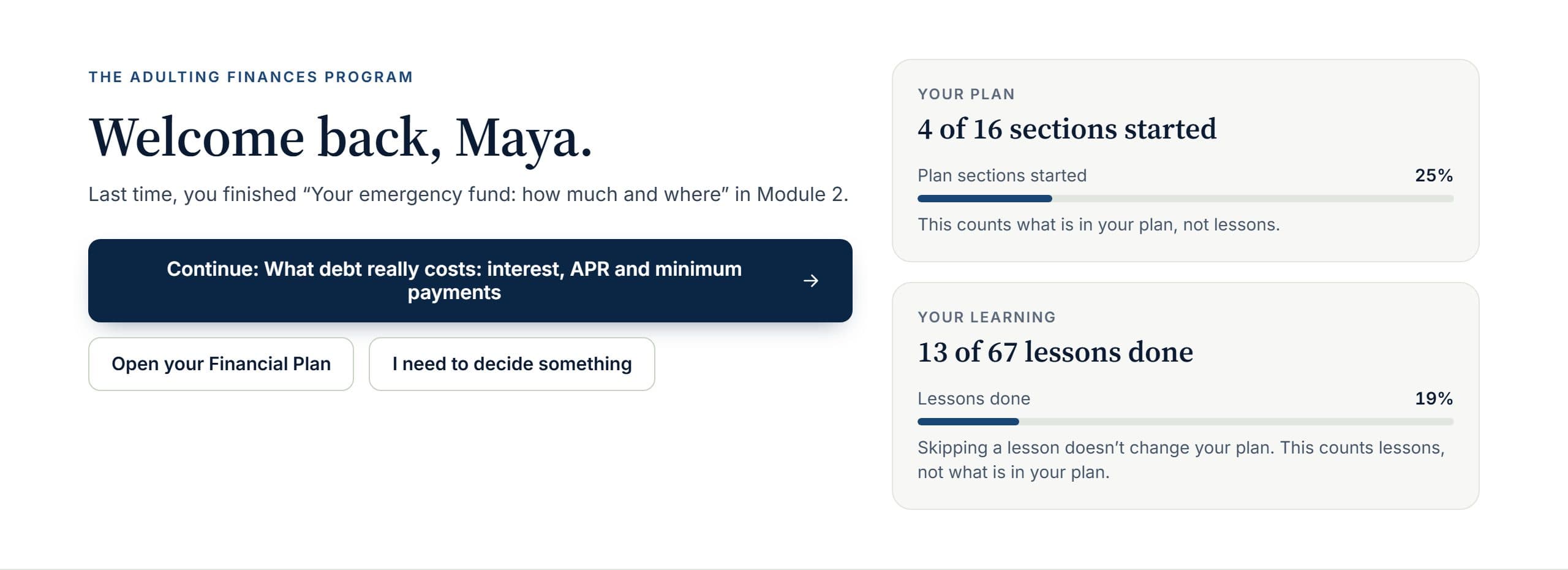
Each lesson ends in the Plan Builder, where you test the idea against your real numbers and keep what you decide. The Plan Builder is included.
- 1LearnOne decision at a time, with the reasoning before the rules.
- 2CheckA realistic scenario tests your judgment, and the feedback explains why.
- 3ApplyRun the idea on your own numbers in the Plan Builder.
- 4SaveWhat you decide goes into your Financial Plan, ready for the next decision.
An example plan
Fictional exampleWhat we know
- Take-home income: $4,600 a month
- Spending plus minimum debt payments: $3,545 a month
- Monthly cash flow: $1,055
- Cash flow
- $1,055/mo
- Runway
- 1.5 mo
- Debt-free at minimums
- 94 mo
Ways to use the $1,055 left each month
- Weighted to buffer1.6 mo runway · 39 mo to debt-free
- Weighted to debt1.5 mo runway · 24 mo to debt-free
- Mixed1.5 mo runway · 39 mo to debt-free
- Weighted to goals1.5 mo runway · 51 mo to debt-free
The Plan Builder lays them out. Choosing is up to you.
Worth a closer look
- Cash covers 1.5 months
- How the payoff timeline is modelled
- Lowering a rate changes the arithmetic
Your Financial Plan
Every part of your money, in one plan you can explain.
Cash flow, debt, benefits, protection, investing and goals: the lessons fill in its 16 sections as you go. After the last one, Decision Labs, the Life Event Hub and scheduled reviews keep it current.
Financial baseline
The monthly numbers every other decision starts from.
Net-worth snapshot
Where you stand today, so you can see direction over time.
Cash-flow system
How money moves on payday without relying on willpower.
Emergency reserve
How much cash protects your plan, and where it lives.
Debt strategy
How you’re handling each debt, and why.
Credit checklist
Keep your credit accurate, protected and ready for big purchases.
Protection review
What’s covered if something goes wrong, what isn’t, and what you still need to find out.
Benefits review
The compensation you’re already entitled to, used on purpose.
Retirement contribution plan
How much goes to long-term accounts, and which ones.
Tax notes
How taxes affect your paycheck and accounts this year, and what to ask a qualified professional.
Investment framework
Your written investment policy: the rules you follow when markets get loud.
Saved decisions
A major decision, the options you compared, and what would change your mind.
Goal hierarchy
Your goals, in the order that matters to you.
Major financial priorities
The three things that matter most for the next 12 months.
Action plan
Specific next steps with dates.
Review schedule
When you’ll check in, so the plan keeps up with your life.
The curriculum
13 modules, built around the decisions you’ll actually face.
Five stages, each building on the last: know where you stand, steady the base, get more from what you earn, invest with a plan, then make big decisions on purpose.
Stage 1: Understand
Know where you stand.
Put your income, spending, debt, assets, benefits and goals in one place so every decision starts from real numbers.
Stage 2: Stabilize
Build a floor under your finances.
Get cash flow positive, build an emergency reserve and stop expensive debt from compounding against you.
Stage 3: Optimize
Get more from what you already earn.
Capture your employer match, understand credit and taxes, and decide which account each dollar goes to next.
Stage 4: Invest
Put long-term money to work with a plan.
Learn how diversification, asset allocation, fees and risk fit together so your investing follows a strategy, not headlines.
Stage 5: Build
Make big decisions on purpose.
Sequence your goals, work through housing, job and relocation decisions, and keep your system working as life gets more complex.
Who’s teaching
Graduate-level finance, taught in plain English.
Ryan Loveless earned an MS in Finance focused on investment management, portfolio theory and quantitative methods, then built Adulting Finances to teach what usually goes unexplained. He’s preparing for the Series 65 exam and isn’t registered as an investment adviser, so everything here is education: how to weigh a decision, never what to buy.
Read Ryan’s story
“Finance gets much easier once someone shows you the framework. I built Adulting Finances to teach that framework to people who were never given it.”
- Education first
- No commissions
- Transparent assumptions
- Clear boundaries
Questions
What people ask before they start.
What is Adulting Finances?
An education company. Its program is The Adulting Finances Program: 67 self-paced lessons, the Plan Builder and a saved Financial Plan you write as you go.
Is this financial advice?
No. It’s education. Ryan Loveless, the founder, is preparing for the Series 65 exam and isn’t registered as an investment adviser. The program teaches you how to evaluate a decision; it never tells you what to buy.
What does it cost?
$1,999, paid once, with no subscription. Access lasts for as long as the program is offered. Refunds: Full refund within 14 days of purchase if you’ve completed less than a quarter of the lessons.
Can I try it first?
Yes. A sample lesson is open to everyone, and a free account opens all of Module 1 and the first sections of your plan. Anything you do there carries over if you enroll.
Who is it for?
Early-career adults, and anyone starting over, who want the whole system in order. The same program covers couples and young families. It isn’t for stock picks, trading signals or anyone who’d have to borrow to pay for it.
Your next step
Stop guessing. Start with a plan.
Learn how it all fits together and build your plan as you go. Not ready to commit? The free checklist is a good first step.